

When homeowners compare RTA cabinets vs. custom cabinets, the decision often gets reduced to a simple formula: RTA cabinets cost less, while custom cabinets are better.
That comparison misses what actually matters.
The real question is whether custom cabinetry solves a problem your kitchen or bathroom genuinely has. In some rooms, made-to-order dimensions and specialized construction can justify the additional expense. In others, well-planned ready to assemble cabinets can achieve the layout, storage, and appearance you want without paying for customization that adds little practical value.
Before choosing either route, it helps to understand where the differences matter - and where they don't.
Start With the Room, Not the Cabinet Category
One of the most common mistakes is deciding "RTA or custom" before developing the layout.
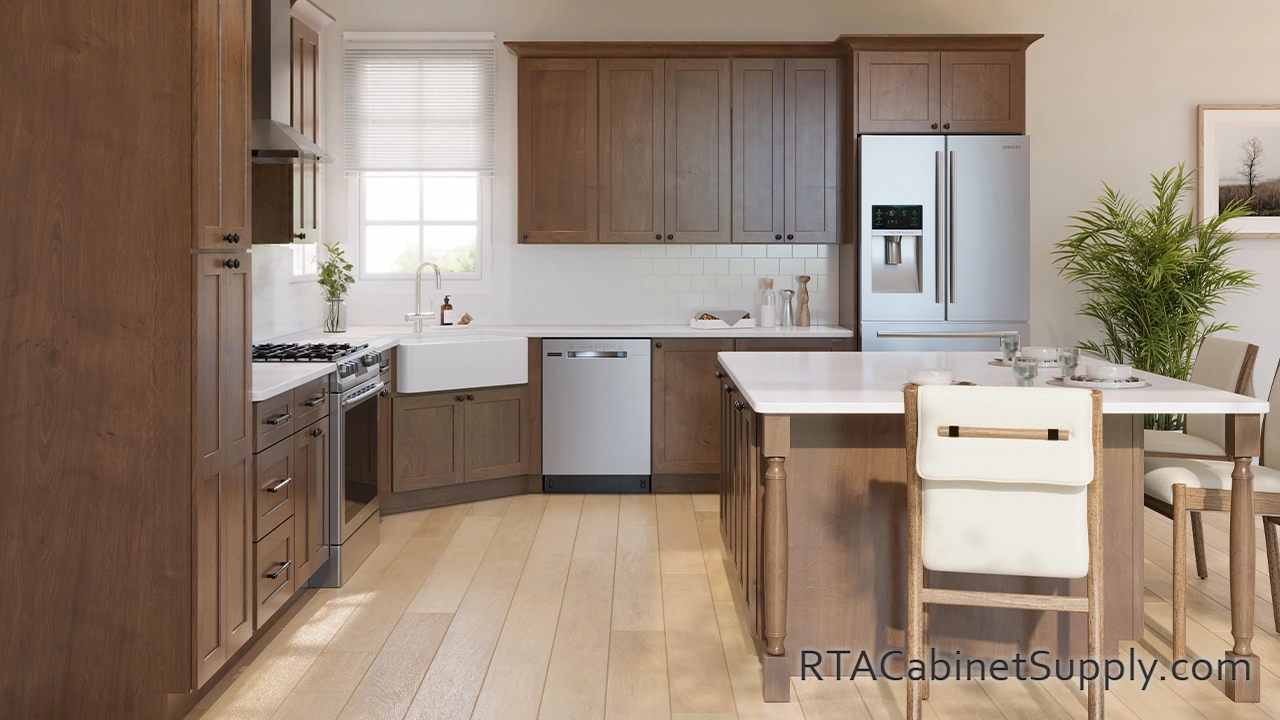
Instead, measure the room and identify its difficult areas first. Look for:
-
Walls that are noticeably out of square
-
Unusual ceiling heights
-
Narrow spaces that standard cabinet widths don't use efficiently
-
Windows, doors, plumbing, or appliances that restrict cabinet placement
-
Corners that require careful planning
-
Architectural details that cabinetry must fit around
A relatively straightforward kitchen may work extremely well with standard cabinet sizes. Small leftover spaces can often be handled with fillers, finished panels, or adjustments to cabinet placement.
Custom cabinetry becomes more valuable when standard dimensions force significant compromises.
For example, suppose a wall could accommodate cabinetry except for an awkward gap created by a structural feature. If standard cabinet sizes leave several inches of unusable space, a custom-width cabinet might turn that area into functional storage.
The important distinction is this: custom dimensions have the most value when they solve a specific dimensional problem.
"Custom" Does Not Automatically Mean Better Construction
Buyers sometimes assume that custom cabinets are inherently stronger or longer-lasting than RTA cabinets. Cabinet category alone doesn't tell you that.
Construction details matter.
When evaluating RTA cabinets, look beyond the fact that they arrive unassembled. Examine the cabinet box construction, drawer construction, shelving, hardware, joinery, finish, and assembly method. Then compare those details with the specific custom cabinet line you're considering.
The same applies to custom cabinetry. "Custom" primarily describes the degree of made-to-order flexibility; it shouldn't be treated as a universal construction grade.
A useful comparison puts actual specifications side by side rather than comparing labels.
Compare the parts you will actually use
Pay particular attention to:
-
Drawer box and drawer-slide construction
-
Hinge quality and adjustability
-
Shelf thickness and support
-
Cabinet box materials
-
Back-panel construction
-
Door and drawer-front materials
-
Finish quality
-
Assembly and fastening methods
This approach gives you a much more meaningful comparison than asking whether RTA or custom is "higher quality."
The Biggest Custom Advantage May Be Fit, Not Appearance
Custom cabinets can provide substantial flexibility in widths, heights, depths, configurations, and design details. That flexibility can be valuable in an unusual room.
But don't confuse customization with appearance.
Many of the visual decisions that define a finished kitchen happen outside the cabinet box itself. Door style, color, hardware, countertop selection, backsplash, lighting, moldings, appliance placement, and proportions all influence how the room looks.
A carefully designed kitchen using ready to assemble cabinets can therefore look highly intentional even though the cabinet boxes use standard dimensions.
This is especially important when budgeting. If standard-size RTA cabinets already create a strong layout, spending more solely to obtain custom cabinet dimensions may have less visual impact than putting part of that budget toward countertops, lighting, or other visible elements.
Don't order directly from rough measurements
A measurement that is "close enough" for early planning may not be close enough for the final cabinet order.
Before ordering, verify wall dimensions, ceiling heights, appliance sizes, window and door locations, plumbing locations, and clearances. Check whether walls are plumb and corners are reasonably square.
Also remember that cabinets need room to function, not merely fit.
A refrigerator door needs clearance to open. Drawers near corners shouldn't collide with neighboring handles. A cabinet next to a wall may need a filler so its door or drawer can operate properly.
These details can determine whether an RTA layout feels professionally planned or frustrating after installation.
Standard Sizes Can Actually Make Decisions Easier
Customization sounds attractive until every dimension becomes another decision.
Standard cabinet sizes impose constraints, but those constraints can simplify the design process. Instead of designing every cabinet from scratch, you work with an established set of components and concentrate on creating an efficient combination.
This can be particularly useful in rental properties, straightforward remodels, secondary bathrooms, laundry rooms, and kitchens where the architecture doesn't require unusual cabinetry.
Custom cabinets make more sense when those standard options repeatedly interfere with the design rather than simply requiring minor adjustments.
Common Mistakes When Choosing Between RTA and Custom
One mistake is focusing entirely on purchase price. Cabinet cost matters, but assembly, installation, modifications, and project complexity matter too.
Another is assuming every inch must become storage. Filling an awkward three-inch space with a highly specialized cabinet isn't automatically better than using a properly sized filler that gives neighboring doors and drawers enough clearance.
Homeowners also sometimes over-customize before appliances are finalized. Cabinet dimensions and appliance dimensions affect each other, so major appliances should be selected—or at least their exact specifications confirmed—before the cabinet order is finalized.
Finally, don't overlook finished ends, moldings, toe kicks, fillers, and panels. These components may seem secondary on a cabinet list, but they are often what makes the installed kitchen look complete.
So, Is Custom Really Worth It?
Sometimes.
Custom cabinetry earns its premium when customization produces a meaningful result: better use of an unusual room, specialized storage, nonstandard dimensions, or architectural detailing that can't be achieved effectively with standard cabinetry.
But if your kitchen works naturally with standard cabinet dimensions, RTA cabinets can be a practical alternative. The key is careful measurement, thoughtful layout planning, and comparing actual construction and project scope rather than relying on category labels.
Before paying for custom, identify exactly what the customization is buying you. If you can point to specific problems it solves, the additional investment may make sense. If you can't, a well-designed RTA cabinet layout deserves a closer look.
Planning a kitchen or bathroom project? Explore RTA Cabinet Supply's cabinet options and start comparing sizes, styles, and configurations against your actual room dimensions.